
Why Joint Replacement Needs a Breakthrough
For many years, people have relied on joint replacement surgery, but it has never been flawless. Every surgeon operates uniquely. Implants don't always line up perfectly. Results aren't always predictable, and recovery can take a long time. If implants are not positioned precisely, even the strongest ones deteriorate more quickly.
The expected lifespan of these implants is between 15 and 25 years. However, that number decreases if the surgeon is even a few degrees wrong. Patients suddenly have to deal with pain, unsteady joints, or repeat the entire process.
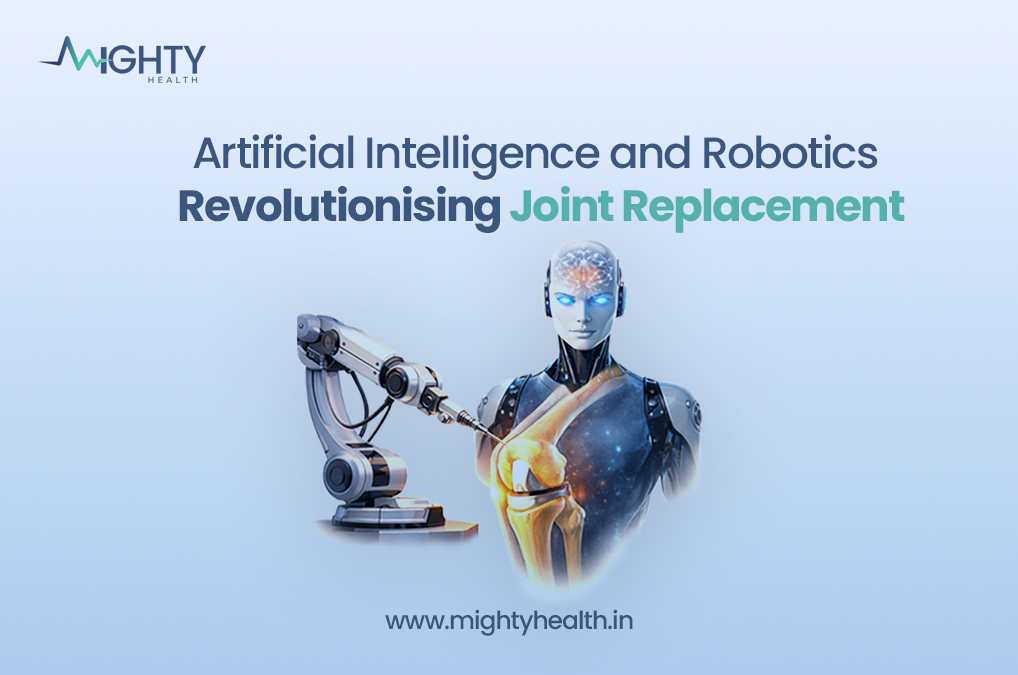
AI and robotics can help with that, and they completely alter the game.
The Dynamic Duo: Al is the Brain, Robotics is the Hand
A lot of people think robotics and AI are basically the same thing, but that’s not really true. They work together well, sure, but each one brings something different to the table.
Take AI with Augmented Reality—AI/AR. Think of it as the brains and the navigator in the operating room.
Here’s how it works. Before the surgeon even picks up a scalpel, AI software looks at your CT or MRI scan. It doesn’t just spit out a 3D image of your joint. It actually lets the surgeon run through a virtual version of the surgery first. The software figures out exactly what size implant you’ll need, where it should go based on your unique anatomy, and even flags possible problems like if the implant might end up unstable or if your legs could turn out uneven. It pulls this off by tapping into a massive database of past surgeries. This is what personalized medicine really looks like.
Now, here comes the cool part—augmented reality. It’s not some futuristic idea; it’s already here. Imagine instead of a bulky robotic setup, the surgeon just puts on a pair of AR glasses. Suddenly, the surgical plan shows up right on the patient’s body—kind of like GPS, but for human anatomy. It makes guiding the procedure way more precise without getting in the surgeon’s way.
Robotic Assisted Surgery(RAS) is the Precision Artist.
Think of Al as the architect who draws up the perfect plan. The robot? It’s like a master craftsman, following those instructions down to the tiniest detail. In surgery, the surgeon is in the driver’s seat, guiding a robotic arm that’s anything but ordinary—it pushes back if you stray from the safe area and gives you real-time feedback.
Al hands you a care plan that’s already mapped out. The result? An implant designed just for you, made possible by cutting bone with crazy precision—down to fractions of a millimetre—while protecting as much healthy tissue and bone as possible.
How Artificial Intelligence is Transforming Joint Replacement
AI-Powered Diagnostics & Imaging
AI tools look at X-rays, CT scans, and MRI images with an accuracy you just don’t get from traditional methods. Thanks to machine learning, they spot tiny changes—micro-anomalies, shifts in bone density, cartilage wear—that doctors might not catch on their own.
Here’s what that means:
- They catch signs of degeneration early.
- They offer surgical recommendations tailored to each person.
- They predict the risk of complications after surgery.
Predictive Analytics for Surgical Planning
To determine the best implant kind, angle, and alignment, AI algorithms evaluate the patient's lifestyle, body mechanics, gait patterns, and medical history.
AI planning systems, for instance, produce a computerised surgery blueprint that includes:
- Choice of implant size
- Angles of cut and bone preservation technique
- Pathway alignment for the best possible load distribution
- Projection of soft tissue balance
This leads to a surgical plan that is as specific to the patient as their fingerprint.
Personalised and Data-Driven Treatment
Instead of using generic templates, AI creates personalised treatment programs for each patient. The strategy is influenced by variables such as age, weight, mobility objectives, and activity level (e.g., athletes vs. seniors).
This individualised treatment enhances:
- Fit and stability of implants
- After surgery, natural mobility
- quicker return to regular activities
Robotics in Joint Replacement: A New Standard of Precision
Robotic systems do not replace surgeons; instead, they are improved. While robotic instruments offer unparalleled precision in bone preparation and implant placement, surgeons maintain complete control.
Robotic-Assisted Surgical Arms
Tools are guided by robotic arms under the surgeon's direction with microscopic accuracy, frequently within millimetres. They stop overcutting, misalignment, and unintentional slips.
Advantages
- Constant precision every time
- Less damage to ligaments and tissue
- Decreased blood loss and scarring
- Reduced chance of revision surgery
Real-Time Intraoperative Feedback
Robotic platforms monitor the patient's anatomy during surgery and modify their execution based on the surgeon's objective. The technology rapidly corrects any movement that deviates from the pre-planned safe zone.
This implies:
- Throughout the process, stability is maintained.
- Accuracy is not compromised by surgeon tiredness.
- Regardless of the complexity of the case, quality is constant.
Muscle, Nerve & Soft Tissue Preservation
Wider exposure is sometimes necessary for visibility when using traditional approaches. Robotics reduces damage and preserves muscles by enabling less intrusive access.
This results in:
- Reduced hospital stays
- Decreased pain following surgery
- Rehab and mobility timetables that are accelerated
Patient-Centric Benefits
This technological synergy is more than simply a showpiece; for patients in our community, it translates into real, transformative benefits.
Complete Customisation: No person or body is alike. You may differ from other people in terms of anatomy, ligament tensions, and bone structures. Al respects this distinction, as does robotic technology. Your implant will feel natural and work well right away because the surgery is tailored to your body. This is a change from the more traditional "one-size-fits-all" surgical techniques.
Faster Recovery, Less Pain: These technologies bring a level of precision that’s tough for any surgeon to match by hand. Surgery gets less invasive, muscles and tendons just get moved aside—not cut. So, there’s less damage, less pain afterward, and barely any bleeding. Most people end up walking the same day they have surgery, and they leave the hospital much sooner.
Better Safety and Predictability: With AI planning ahead and the robot doing the exact work, there’s way less room for human error. The chance of a bad implant drops. Surgery feels a lot more controlled and predictable, and people stay safer.
Longer-Lasting Implants: If the implant goes in perfectly, it wears down evenly. That’s a huge deal over time. With everything lined up just right, the implant doesn’t take as much stress, so it sticks around much longer. For a younger patient in Delhi, that can mean their new joint lasts their whole life.
Addressing Common Concerns: Cost, Trust, and the Human Touch
Questions concerning this new paradigm are understandable.
Is the price too high? It is true that hospitals must make a large investment in order to use this technology, and there may be associated costs. For a better result, it is crucial to view this expense as an investment rather than an extra price. Modern, precise, and correct surgery will result in fewer difficulties, allow for a quicker return to work, and potentially prevent costly revision surgery down the road. The expenses should go down as the technology spreads throughout Delhi NCR's hospitals.
Is the surgeon going to be replaced? - Certainly not. Understanding this is the most important thing. Al supplies the information and the strategy, but the surgeon uses their astute malpractice assessment and validation. While the surgeon maintains complete control and uses their malpractice abilities and expertise to handle the changing operating room environment, the robot will supply and depict the boundaries for them. Instead of taking the role of the surgeon, the technology improves and raises their circumstances. It is the ideal union of human knowledge and machine accuracy.
Is it safe? These systems are constructed with multiple levels of redundancy and safety checks. The tool won't function outside of the designated area thanks to the haptic feedback border. Every action will be immediately documented and approved.
The Indian Context: A Leapfrog Moment in Healthcare
India, and Delhi specifically, are in a unique position to surpass traditional surgical methods. We have integrated digital technology into every part of our lives; why should the healthcare industry be any different?
Today's patients are better educated and have higher expectations; they want the greatest surgery possible with the least amount of disturbance to their lives, not just a procedure. Incorporating AI/AR and robotics into medical facilities like ours makes Delhi a global destination for medical tourists, but more significantly, it gives our residents access to top-notch care.
As part of a broader institutional dedication to this new, data-driven standard of patient care, we are leaders in advanced joint replacement.
To Conclude…
AI/AR and Robotics are complementary technologies that are not competing, but transforming arthroplasty. Both Al/AR and robotics improve cognitive planning, precision and predictive potentials and improved results. Their combination forms a continuum of data-driven workflow that enhances surgical outcomes and minimises the incidence of complications and personalised patient care. Despite the current challenges such as cost and training, the synergistic potential of AI/AR and robotics is expected to characterise the future of Orthopaedic surgery in these aspects: Joint Replacement is safer, more efficient and more accessible than it has never been before.
This is not the story of AR and robotics being pitted against each other, but the merger of the two technologies to generate the new standard of care in arthroplasty.
The present-day gold standard in performing a pre-determined plan with a level of precision of less than one millimetre consistency is robotics, which provides unmatched consistency.
The next step is Augmented Reality: an interactive and information-rich application that allows improving vision and decision making in the surgery room, without losing the feel and flexibility of the surgeon.
Robotic systems that use AI and AR will be the new reality, as the surgeon designs and visualises the operation using an AR headset, and then can easily control a robotic arm to implement the design in a shared immersive environment. This would enable the surgical team to have the increased visualisation of AR and the accuracy of robotics implemented within a hybrid mechanism that would eventually allow greater customisation of planning, real-time visualisation and high results during the surgery that would maximise the outcome of the patients undergoing hip and knee arthroplasty.
To any person in Delhi who is thinking about having a joint replacement done, we cannot tell you that the time of ignorance is well behind us. The future will be customised, accurate and foreseeable. It will be the day when technology and human potential will be in harmony to heal not only your joints, but your life, and you will be at ease and respectable. The revolution is naturally silent, but the difference that it will bring in the lives of the patients will be big and reverberating around our city.