
The Basic Problem: A Disc That's Given Up
Every vertebra is separated from the next by cushiony discs. This disc absorbs shocks and provides mobility to the vertebrae. Unfortunately, over time, or because of an injury or bad hereditary factors, these discs can wear out, bulge, rupture, or collapse. If that happens, it may compress the nerve nearby causing the vertebrae above and below the injured vertebra to slide or grind against each other and result in debilitating pain.
However, most individuals will not require surgery for this. Most of the time, the issue can be solved with the help of physical therapy, medications, and injections. Nevertheless, for a smaller part of patients, conservative treatment will not help, and that is where the question arises about when is spinal fusion necessary comes up and about whether a disc replacement would be smart solution.
What Spinal Fusion Actually Does
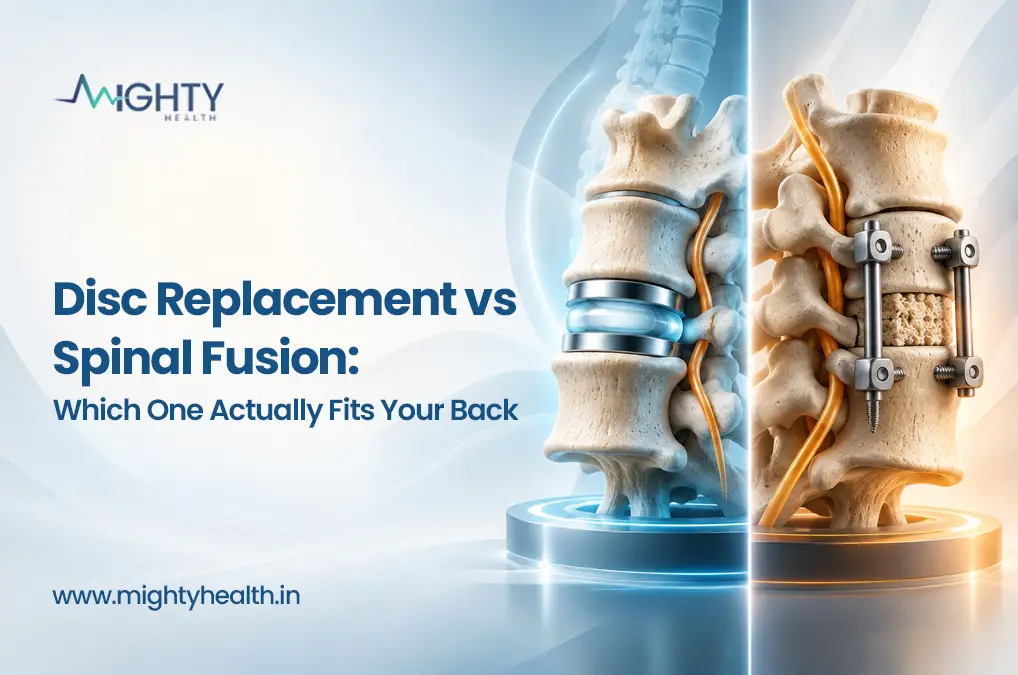
Spinal fusion is a surgery that connects two or sometimes more vertebrae, turning them into a single, solid unit. The surgeon takes out the damaged disc, puts a bone graft or a synthetic spacer in the open spot, and usually adds screws and rods to hold everything steady. After the operation, your body takes over—it grows new bone across the gap, locking the vertebrae together for good.
The idea here isn’t complicated. If a joint in your spine is shaky or causing pain, and there’s no safe way to save its movement, the obvious fix is to stop it from moving at all. Surgeons use this approach for issues like spondylolisthesis (when one vertebra slips over another), collapsed discs, spinal curve problems like scoliosis, or instability left behind after treating a disc problem that decompression alone couldn’t solve.
Lumbar fusion—done in the lower back—is one of the most common types because the lumbar spine carries much of your body’s weight and put up with a lot of stress. So if a doctor says you need an L5 S1 fusion, for example, they’re talking about fusing the bottom two vertebrae, right where the spine meets the pelvis. This spot does a lot of heavy lifting, which is why it’s a frequent target for both disc wear and fusion surgery.
Of course, fusion comes with a catch: you lose movement at that level. Those vertebrae won’t bend or twist anymore. Your spine ends up sending a bit more of that action to the nearby joints, which most people handle without trouble, but it does change how your back moves.
What Disc Replacement Does Instead
In disc replacement, the idea is totally different. The doctor will surgically remove the degenerative disc and then put in its place an artificial disc that usually consists of either metal or medical-grade plastic. This artificial disc is supposed to behave in the same way as the normal disc does: flex, bend, and act as a cushion.
This is clearly a good idea. When the operation is performed successfully, the affected part of the spine will continue to move in the same way as before, and the adjacent vertebrae won’t have to do any additional work. Of course, such an approach is very beneficial for young and active people who strive for keeping their natural movement.
However, not all patients are suitable for this procedure. First of all, disc replacement is only done if the surrounding bone is in good condition, there’s no arthritis of the facet joint, and there’s no instability of the spine. Patients with osteoporosis, prior surgeries of the spine in the same place, deformity, or facet joint arthritis should be operated with fusion.
Comparing the Two Head-to-Head
This is where the actual decision is made in real consultations.
Recovery time. People who have undergone disc replacement generally recover faster compared to those who go through fusion surgery. The reason for this is that they do not have to wait for bones to heal. Fusion patients usually must deal with much longer recovery process as the entire purpose of the surgery is based on bones fusing properly for a certain amount of time.
Long-term spine mechanics. This is what the argument is really about. Fusion stabilization stops motion at the specific segment, which some surgeons consider the reason for continuing deterioration of neighboring areas over time, and this is what is known as adjacent segment disease. Disc replacement avoids this issue thanks to the fact that it does not stop motion in the segment, yet it raises the question about effect of artificial implant mechanism durability in the long run.
Eligibility criteria. The fusion procedure can be applied in a wider variety of cases. It is used for instability, deformity, multilevel condition, as well as for those instances when the anatomy around cannot qualify for an artificial implantation. The disc replacement operation has more strict indications – it is performed in case of one affected disc, young age of the patient, normal bone density, and absence of degeneration at the joint.
Reoperation and hardware. The surgeries both include implants and both have a low probability of the need for another surgery later on. In the first case, the hardware is to become unnecessary after the complete fusion of the bone. In the latter case, the artificial disc is going to stay a working mechanism for the whole life of the person.
Experience. Fusion surgery has been around for many years now and has a huge amount of scientific research backing it up, including advances to the technique of back fusion operation itself such as approaches from the front, back, or side of the spine, minimally invasive methods, and better graft material. Disc replacement surgery is a relatively new method used in the lumbar area (has a longer history in the neck), but results have been positive thus far.
So Which One Is Right?
This cannot be determined universally, and every reputable surgeon will agree with this point of view: it all depends on the specifics of your anatomy, your age, your level of activity, and the exact problems associated with your spine.
As a rule, the disc replacement procedure is recommended to young patients who have one-level discopathy, healthy bones, and the absence of arthritis or instability of adjacent joints. Spinal fusion is generally preferred when it comes to instability, deformity, multiple levels, previous surgeries, or lack of anatomic fit for the artificial disc.
In case your surgeon recommends you to undergo the spinal fusion surgery, it is reasonable to ask why precisely this procedure is being used, not the disc replacement one. This way, you can get some additional information concerning your imaging, for example, the presence of arthritis of the facet joint or instability that could not be treated by mobile implants.
What Recovery Actually Looks Like
No matter which road is taken, there will not be an immediate recovery. Fusion patients usually need one to two weeks without bending, lifting and twisting. This leads to two or three months of gradual return to regular movement and up to six months to a year to achieve full bone fusion.
Physical therapy will play a key role in regaining strength and confidence in movement after the healing phase is done.
In disc replacement, patients recover a little faster in terms of the first weeks, because there is no waiting period for bone healing to occur, however, patients will still need to be careful about returning to activities gradually and according to their doctor’s recommendations about lifting restrictions.
It should be kept in mind that even though the surgery is important, following the post-operation instructions, going to physical therapy, quitting smoking (which interferes with bone healing in fusion patients) are equally crucial factors.
The Bottom Line
The point is that fusion and disc replacement are not competitive procedures, rather they are just two different procedures tailored for two different purposes. The former offers stability at the cost of mobility and has a long history of experience and numerous cases treated throughout the decades. The latter sacrifices some versatility in order to keep the natural movement possible for the patient.
So when you have to make this choice, the best option you can get is to ask your doctor to tell you exactly what is wrong with your spine, why he/she chose the given procedure, and how will your spine look and feel like after 5 and 10 years.