
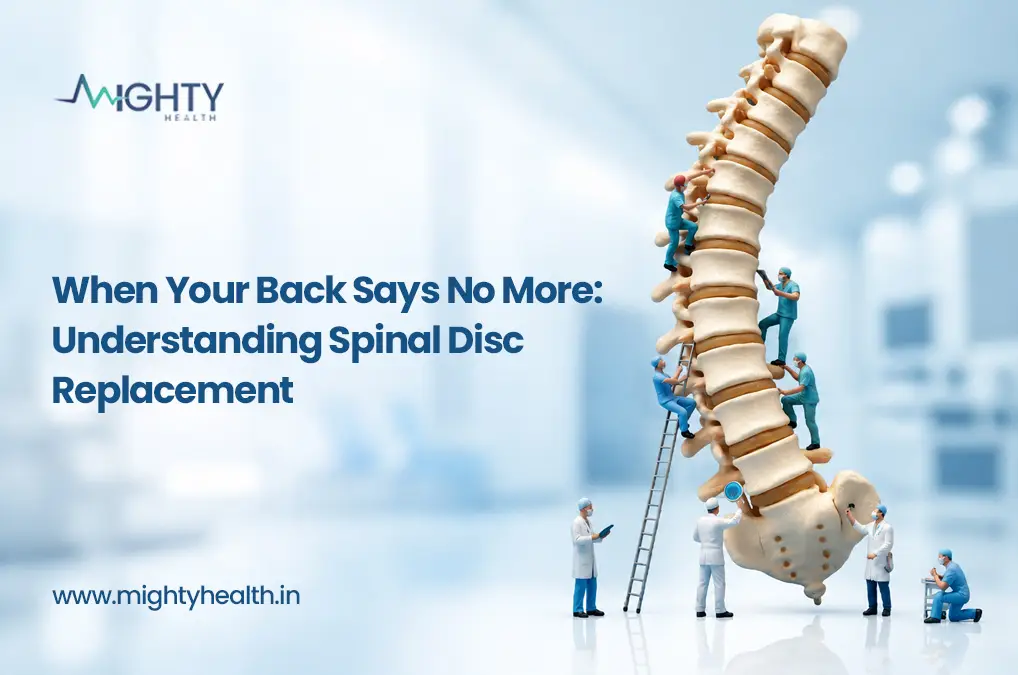
For any individual who has suffered through years of agony while bending to tie their shoes, the term "back pain" does not quite do justice to the experience. This means no weekend hiking trips, no fear of long drives, no calculations made before each sneeze. After everything else fails to provide relief, individuals are left with the option of visiting a surgeon to talk about the possibility of undergoing spine surgery, including spinal disc replacement.
This is an operation which seems mechanical, replacing a damaged part with another. However, just as most things related to the human body, spinal disc replacement is not as simple as that. Here's a peek into what spinal disc replacement really entails, who is eligible for the procedure and what life after spinal disc replacement is all about.
The Disc's Quiet, Thankless Job
Each vertebra in the spine is separated by a small, cushiony disc which is composed of a tough outer ring and a gel-like center. The function of each vertebra is similar to that of the shock absorber and helps in bending, twisting, and reaching for high shelves without any friction between the vertebrae. As a rule, the discs are doing their jobs silently until something goes wrong.
Over time, the discs suffer from dehydration, flattening, bulging, or herniation. With time, discs may wear down and stop performing their functions. When a disc becomes irreparably damaged, it starts having a great effect on nearby nerves and leads to several serious medical complications. That creates an unbearable pain in arms and legs, numbness, weakness of muscles, or constant discomfort.
Traditionally, the solution to the problem with a serious disc was to remove it. It means that the two vertebrae were fused together limiting any physical movements in that particular part of the spine. This approach is widely accepted today but there are more ways to treat that problem.
Enter the Artificial Disc
The process of spinal disc replacement otherwise known as artificial disc replacement follows a different concept. Rather than immobilize the affected joint and fuse the disc in place, doctors perform a surgical procedure that entails eliminating the affected disc and installing an artificial device that acts like a normal disc and performs the functions of a disc such as shock absorption and movement preservation in that area of the spine.
Most spinal implants consist of metals or a combination of metals and medical-grade plastics that are manufactured to enable them to flex and rotate similar to a normal disc. The basic idea therefore is simple yet appealing: the pain in the patient is alleviated without sacrificing the healthy range of motion of the spinal column and probably the extra stress caused by fusion on the surrounding disc.
The method can be classified under the general category of back operations aimed at dealing with chronic pain related to disc pathology most frequently taking place in the lumbar (lower back) and cervical (neck) regions of the spine since most of the daily load is imposed on these regions.
Who Actually Needs This?
The matter that needs to be considered ahead of getting emotionally attached to the concept of disc replacement is that not all patients complaining of back pain qualify for the procedure. In most cases, candidates for disc replacement will be those patients who:
- Have one, maybe two, degenerated discs that cause severe continuous pain
- Have not responded to conservative methods like medications or physical therapy over a long period of time
- Have surrounding bone and joint tissue that is healthy enough and does not have signs of severe arthritis or instability
- Have no significant spinal deformity, infection, or osteoporosis
Young active patients are considered to be better candidates for this procedure since they usually suffer from problems with a specific degenerated disc rather than the entire spine. This is what makes the discourse on disc replacement and fusion so relevant in the context of surgical treatment.
What Actually Happens During the Procedure
To have a spinal disc replaced, surgery is performed while the patient is under general anesthesia. The surgical approach can differ based on the area of the spine being treated. In the lumbar region, the surgery is performed through an incision made from the abdominal part, whereas surgeons would perform the surgery through a small incision at the front of the neck in a cervical spinal disc replacement.
Once the damaged disc is taken out, the area between the vertebrae is prepared for the insertion of the artificial disc. The disc is put into position within the spinal disc space so that its height is restored and compression is relieved and natural movement is allowed. The incision that was made during the surgery is closed and the patient is moved to recovery.
Typically, the entire spinal disc replacement procedure lasts a few hours, but the exact time is determined by how many levels have been treated and if there are any other issues that need to be treated as well.
Recovery: Slower Than You'd Like, Faster Than You'd Fear
Let's get straight to the point concerning recovery after any type of spinal surgery: it is rarely quick, but it's rarely as terrible as one might think beforehand.
Depending on the type of surgery done and the post-surgery response of the patient, one will spend one or a few days in the hospital. Walking is actively encouraged as soon as possible – usually the next day – because it improves blood flow and aids healing.
After some time has passed since the surgery, patients begin to return to their everyday lives. The first things include light housework and walking. Driving, working at a desk, exercising – all of these can be included in the list later on. Sometimes physical therapy is prescribed in order to restore the strength and improve movement patterns.
As for full recovery, which is complete healing and absence of restrictions concerning activity, it usually takes a few months; however, many patients feel the positive effect sooner than that. As we know, every patient is unique, and that is why healing times differ due to various factors like age, general condition, occupation, and the type of the operated vertebrae.
Weighing the Trade-Offs
Like any medical procedure, spinal disc replacement carries a number of dangers. Possible complications include infection, blood loss, irritation of nerves, and issues with the prosthesis, for example, dislocated or worn-out implant. In some cases, follow-up surgery may be performed. Because lumbar disc replacement entails surgery near the major blood vessels, it has a somewhat different risk profile compared to other procedures.
The prospect of having preserved mobility at the treated part of the spine, reduced tension in adjacent vertebrae possible compared to fusion, and significant and lasting relief from pain is attracting many patients to spinal disc replacement.
On the other hand, disc replacement surgery does not necessarily mean that it is any “better” than spinal fusion surgery; it just means that it is an entirely different technique and is appropriate for certain scenarios. There are many people out there whose condition may suit spinal fusion surgery far better than disc replacement, while others have conditions that could be better managed with motion-preserving techniques. This is precisely why a proper discussion with a spine specialist is so important.
The Bigger Picture on Back Pain
Many people might perceive back pain as something they have to deal with on their own, and this is certainly true for many going through conservative treatment options which can actually bring real results — physical therapy, exercise, anti-inflammatories, and time usually suffice to treat a surprisingly big number of cases without resorting to surgery. Surgery including spinal disc replacement usually comes into play only after all conservative measures have been tried.
However, people who suffer from pain that has persisted for a long time, and who also have conclusive scans pointing at a clear treatable cause can greatly benefit from spinal disc replacement.
If you happen to be in this situation yourself, the best thing you could do is ask your surgeon a lot of questions about how this particular device works, how viable it is compared to other treatment options, and what your imaging shows of your spine. Surgery should not feel like a mystery, and an informed patient usually faces surgery with much less anxiety.
Read more about: Neurogen Brain and Spine Institute, Mumbai
Frequently Asked Questions (FAQs)
Is spinal surgery major surgery?
Yes, because it involves fragile elements like the spinal cord, nerves, and bones, spine surgery is typically regarded as significant surgery.
How long does it take to recover from a spinal surgery?
According to the Hoag Orthopaedic Institute, it might take anything from four weeks to twelve months, depending on the particular operation you had.
What is L1, L2, L3, L4, L5 spine?
Your lower back, or lumbar spine, is made up of the L1 to L5 vertebrae. Lower back discomfort and disc problems are most frequently found in the L4–L5 section.
What is the most common spine surgery?
Depending on whether the objective is simple nerve decompression or stabilisation, the most common spine procedures are discectomy (more especially, microdiscectomy) and spinal fusion.
What are the three types of back surgery?
The three most popular back surgery procedures are spinal fusion, laminectomy, and discectomy.
How long does it take to recover from back surgery with rods?
It usually takes between six and 12 months for the bone to heal from surgery where rods were inserted (spinal fusion), although partial recovery and getting back to normal activities can be achieved within three to six months.
Is back surgery a serious surgery?
Although catastrophic complications like paralysis or death are uncommon, back surgery entails standard surgical and spinal-specific risks.
How much should I walk after spine surgery?
As your body heals, you should progressively extend the duration of your short, frequent indoor walks, which should last three to five minutes multiple times a day.
Which surgery is best for the spine?
Your particular diagnosis, the precise location of the issue, and your symptoms will all determine the optimal spine surgery.
What should I expect after back surgery?
You should anticipate a graded healing process following back surgery that includes pain management, stringent activity limitations, and gradual rehabilitation.
Can I climb stairs after spine surgery?
After spine surgery, you can climb stairs, but you have to do it cautiously and gently. This normally begins in the first few days under the supervision of physical therapy before you leave the hospital.