
If you've been dealing with knee pain for many years, you're likely familiar with the subtle considerations that influence your daily life. You think about which staircase has a handrail, whether you can postpone grocery shopping, and how long you can stay on your feet at a wedding before discomfort sets in. Eventually, for countless individuals, the consideration shifts from “how can I cope with this pain?” to “is it time for me to consider a knee replacement?”
When this thought arises, it often brings up several additional questions: What exactly will be replaced? What materials are used in the implant? How durable is it expected to be? Will my new knee feel like my old one or something entirely different? This article addresses these concerns—not in a tedious textbook style—but by offering information that enables you to engage thoughtfully with your orthopedic surgeon.
What Does “Knee Replacement” Actually Mean?
Many people are often surprised to discover that knee replacement surgery does not involve the total removal of their knee. Our knee is actually composed of the meeting of three bones — our thigh bone (femur), shin bone (tibia), and kneecap (patella). The smooth cartilage wears away over time due to injury or arthritis and causes the three types of bones to grind against each other. This is the source of our pain, stiffness, and swelling.
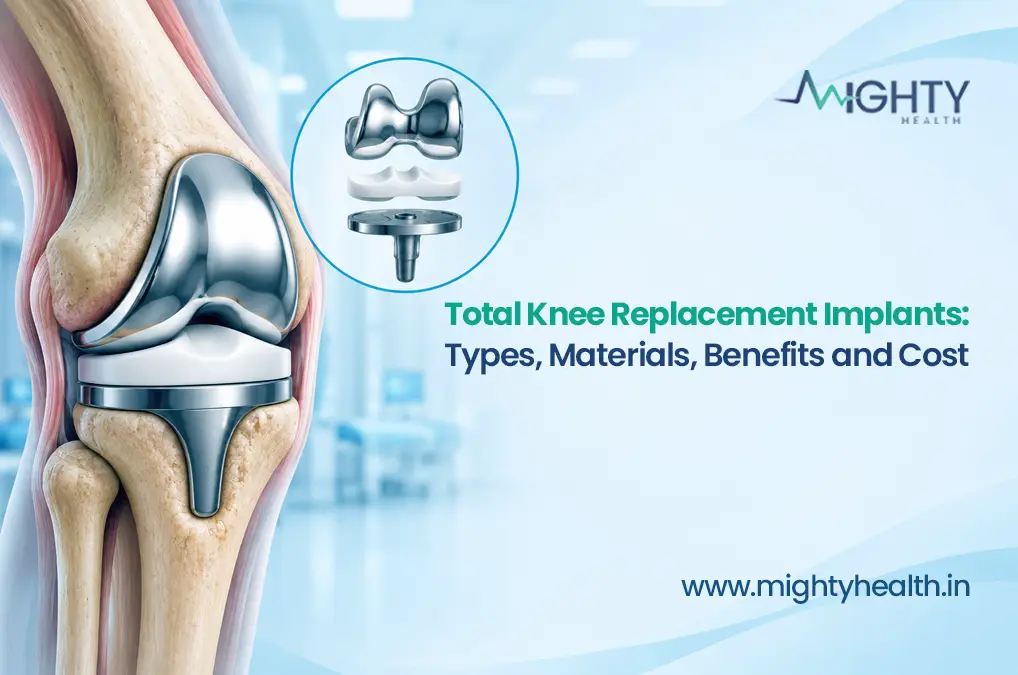
In total knee replacement, the surgeon does not take out the entire knee, but only the ends of the bones. Thus, they cover the damaged ends of the femur and tibia and put the spacer in between. At the same time, the kneecap can also be replaced. This way, we will get a new surface that requires less energy while keeping its moving capabilities.
In terms of the mechanism, knee replacement surgery is closer to a brake pad replacement than an engine swap.
The Three Types of Knee Replacement Implants
Not every knee injury requires the same remedy. Depending on how much of the joint is impacted, surgeons typically select one of three major types of implants.
This procedure is done in case the arthritis has destroyed the majority of the knee joint. In this surgery, all three compartments, namely, the medial, lateral, and patella facets, get resurfacing. This is the most preferred treatment method for advanced osteoarthritis.
Partial (Unicompartmental) Knee Replacement
In the event of only partial damage in the knee, mostly the inner side, which involves more weight bearing, partial replacement can be performed wherein only the damaged compartment is resurfaced, leaving the healthy bones, cartilage, and ligaments intact. The advantage of this approach is that one can avail smaller incisions, shorter recovery times and a more ‘natural’ feeling knee compared to full replacement. The bad part is that this method can be performed only in carefully screened individuals, and there can be a slightly enhanced chance of further surgery in case of the development of arthritis in the untreated areas.
Revision Knee Replacement
A previous knee implant that has become loose or malfunctioned must be replaced, which can occur as early as within 15-25 years, with complications like infections or mechanical malfunctions speeding up the process. Because revision surgery is difficult, it typically involves special medical devices that have longer stems for better integration into the previously treated bone.
It's important to also consider the design aspect: we have cruciate-retaining (CR) implant types that keep one of the knee ligaments intact for greater stability, and posterior-stabilised (PS) implants that take the ligament's responsibilities over with a mechanical system. Based on the state of one’s ligaments and anatomy, the surgeon will choose one of these two types.
What Are Knee Implants Actually Made Of?
Given that this technology will remain inside your leg for decades, it makes sense that many patients are intrigued by this.
Metal Alloys
Femoral and tibial components are usually made of cobalt-chrome alloys or titanium alloys on some rare occasions. Such materials have been selected because of their strength, corrosion resistance, and biocompatibility; that is, the human body accepts them without rejecting or inflaming them. Cobalt-chrome has proven to be excellent due to its smooth wear properties when interacting with plastics.
Medical-Grade Plastic (Polyethylene)
The space between the metal elements has been filled by a spacer created with the material known as ultra-high-molecular-weight polyethylene. This material is a specially made plastic that serves the purpose of absorbing shocks and enabling smooth movement in a manner comparable to that of cartilage. The invention of a new method of processing this plastic, known as cross-linking, has greatly contributed to the reduction in wear over the years as compared to implants from the previous generations.
Ceramic Components
Ceramic-coated or ceramic-based implants are not that often used, but it is becoming more common among those with allergies and sensitivities against metal. The ceramic material is very smooth and scratch-resistant which helps reduce the wear of the plastic spacer, although at a higher expense than other methods.
Fixation Method
There are two methods of fixing implants to bone: cemented, involving the use of quick-setting bone cement for immediate strong attachment (used more in older patients or patients with weak bones), and cementless (press-fit), where the implant has a rough surface that allows the passage of natural bone into the implant over a period of time (often used for younger patients with good-quality bones). In some cases, surgeons successfully use a combination of the two techniques.
Why People Choose to Go Through With It
The decision to have knee replacement surgery is not a simple one, and many patients put it off for many years. However, when pain becomes severe enough that it affects how you live your daily life, there is little doubt that the benefits of this procedure exceed any fears that you may have.
Significant reduction of pain. For many patients with severe arthritis, the replacement of the destroyed joint surfaces allows for the removal of the bone-on-bone friction that was causing pain in the first place.
Ability to move again. One of the improvements resulting from knee replacement surgery is the opportunity to walk, dance at family events, climb stairs, and do gardening and various other activities that have been absent from a patient’s life for years.
Return to knee stability. Chronic cases of arthritis may lead to distortions of knee alignment, especially by making it bow inward or outward. Performing knee replacement surgery allows patients to regain normal alignment and unload the hip and lower back.
Permanent results. Today’s implants, thanks to advanced polyethylene and better surgical methods, have become capable of lasting up to 20-25 years in the overwhelming number of patients, which is certainly an achievement when compared to the implants of a previous generation.
Improved sleep and psychological state. It is not mentioned very often, but chronic pain in joints influences sleep significantly and ultimately affects the emotional state of a person. The change in the quality of the night's rest after the procedure is considered nearly as important as the mobility restoration.
What About Recovery?
Different recovery timelines exist in the literature, but for the majority of cases, patients will be able to stand and walk in a day. In contrast to earlier treatment methods, physiotherapy is now initiated in a short period of time after the operation. Most patients are able to return to their normal lives in a month or two; however, it may take as long as about a year for the patients to get fully what they should expect from their knees.
So, What Does It Cost?
Cost is the elephant in the room, which differs substantially depending on the location, hospital, implants used, and whether it is a total or partial replacement surgery.
In India, which has become a popular place for such surgeries thanks to its high-quality surgeons and comparatively low prices, the total knee replacement surgery for locals usually costs around $4,000 to $7,000 per knee, whereas for foreigners the cost is a little bit higher – around $5,500 to $9,000 – taking into account the premium implants used and extra hospital services.
Generally, the price includes the implant, the doctor's and hospital fees, anesthesia, hospital stay, and physiotherapy at the beginning stage after the surgery; however, you need to make sure of all services that are included.
The Bottom Line
While knee replacement surgery does not simply mean replacing a worn-out knee but regaining life itself through that process, learning the different types of implants available, the material used for them, and the actual nature of the procedure involved would turn this scary-sounding choice into an informed one. If your daily routine is being dictated by constant knee pain, it might be wise to discuss with your orthopedic surgeon which type of implant will suit your particular knee best, since a well-performed procedure is sure to become a forgotten part of your normal life soon enough.
Want to Know: Knee Meniscectomy Treatments in India
Frequently Asked Questions
Which knee implant material is best?
There isn't a one "best" knee implant material that works for everyone; instead, it varies on your age, degree of activity, bone quality, and whether or not you have metal allergies.
What materials are used in knee replacement implants?
In order to minimise friction and mimic natural joint movement, knee replacements are mainly composed of a blend of high-density plastic and metal alloys.
What type of knee replacement is most successful?
The TKR is regarded as the most successful surgical operation, having a high success rate of between 90% to 95% of TKRs working properly 10 years or more post-operation.
What is the newest type of knee replacement?
Instead of a brand-new artificial joint material, the most recent significant developments in knee replacement are "smart knee" implants and robotic-assisted or muscle-sparing surgical procedures.
How many years does an artificial knee last?
Total knee replacement normally lasts for 15-20 years, with roughly 90-92 percent of the implants still being functional after 20 years. For elderly people, an implant that is currently available can serve throughout their lifetime.
Read Also: Knock Knee Surgery Treatments in India