
Having a new knee is a definitive choice - and even tougher to handle. Different patients find it surprising that the operation is even easy. What you have to deal with that will determine if you’ll be able to play golf or will have trouble going down some stairs is done in the weeks after surgery. If you are recovering or about to undergo a knee replacement surgery, understanding what rehabilitation entails will make the difference in recovering successfully.
Let’s find out what you can expect in terms of time and steps that you will have to take to make recovery easier.
The First 48 Hours: Setting the Foundation
Initially, after your surgery, movement will not be your top priority – rather, you will need to wake up your muscle tissues surrounding your new joint and improve your blood flow. In most cases, hospitals encourage you to start sitting up and even walking short distances within one day of the procedure. Early movement will not only build your confidence but is scientifically known to lower the chances of forming blood clots and joint stiffness.
Managing pain is another aspect that starts from the very beginning, and it is not just about “taking the pills.” You may be prescribed oral medication, use ice treatment, or undergo nerve blocks to make sure you don’t feel excessive pain and, at the same time, can actively engage in early physical therapy exercises. You will not want to be a macho here and refuse medication to “toughen up” because uncontrolled pain initially prevents your rehabilitation progress.
Week 1–2: Learning to Walk Again
And that is when you begin walking post-knee replacement. Normally, patients will go back home a few days after surgery, using either a walker or crutches. Walking fast is not the aim, but consistency. Frequent short walks (walking back and forth from the bathroom, for example) are better for you than one long, tiring walk.
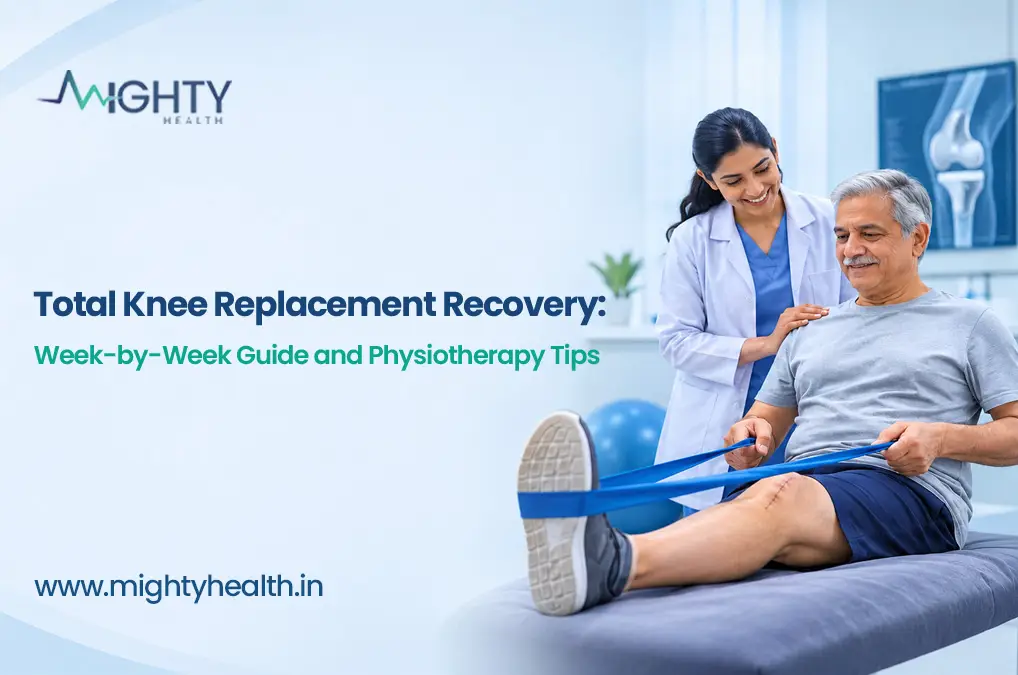
The first physiotherapy exercises for your knee replacement will be introduced by your physiotherapist almost immediately after surgery. They concentrate on the following aspects: restoration of range of movement and activation of the quadriceps muscle that normally goes to sleep after surgery. Here are some typical exercises at this stage:
Ankle pumps: Moving the foot up and down to promote circulation and prevent clot formation.
Quad sets: Tightening the quad muscle in the leg while the leg is straight, holding for a number of seconds.
Heel slides: Moving the heel slowly towards the buttock area when lying flat to enhance flexibility.
Straight leg raises: Once the strength in the quadriceps has been gained, raise the leg while maintaining a straight knee joint.
These exercises may appear quite simple and not of any significance, but they are the basis of all future treatments. Failure to perform these, or to perform them lazily, is one of the major causes of failure in the future treatment process.
Post-surgery swelling is quite common and may be shocking for a patient at his/her first experience. Keeping the leg elevated above the heart level and applying ice for 15-20 minutes a number of times daily is a good way to control swelling. A little bit of bleeding is also quite expected since the body fluid flows downwards due to gravity.
Know more: Partial Knee Replacement Treatments in India
Week 3–6: Building Strength and Confidence
Most patients realise some kind of improvement around this third week mark. Pain that was once acute has softened to more of an ache; the distance one can walk will be much further than before. This is generally the time when most patients begin to use a cane instead of a walker, although this timeline may vary depending on one’s fitness prior to surgery and the regularity with which one performs exercises.
It is common for physiotherapy treatments to become increasingly aggressive throughout this time period. One may see:
- Stationary biking with no resistance; this will aid in increased circulation and flexibility.
- Wall squats or squats performed with the help of a counter.
- Step-ups on a small platform; this helps build up functional strength.
- Balance exercises because after surgery, one’s ability to feel one’s joints in motion is compromised.
Pain management should change at this time as well, as most patients will not require strong drugs anymore and can take over-the-counter medication along with icing as needed.
Week 7–12: Returning to Daily Life
It is usually the most positive period. Most people can walk without a brace or crutches by week eight or nine, while some may even start driving again after being able to do an emergency brake comfortably and safely, typically by the end of week six to eight, based on the leg that was surgically treated.
Now, your exercises become functional rather than clinical. Instead of individual movements, physiotherapists tend to incorporate exercises that simulate everyday activity. It can be anything from walking on an uneven surface, climbing up and down a flight of stairs, entering and exiting a car, or walking and carrying a small bag. The goal here is not only to strengthen your knee but also to restore confidence in its stability.
Patients commonly claim that their knee “feels like their own” by week twelve, although complete recovery can actually take a whole year.
Home Safety: Don’t Underestimate This
Recovery can include a lot that takes place far away from the gym or physiotherapy session; recovery takes place at home. The falls during the beginning phases of recovery are very common and very easily prevented with some preparation.
Prior to the surgery, or right after, it may be useful to:
- Remove any loose rugs or obstacles along any walking routes.
- Install a raised toilet seat and some grab bars in the bathroom.
- Put a sturdy chair with armrests in common areas because getting out of low, soft couches is unexpectedly hard when just recovering.
- Keep often needed objects at waist level to prevent bending or stepping up on a step stool.
- Make sure there’s adequate lighting in the house and in the bathroom.
It seems excessive until you become that person in the dark who needs to get to the bathroom at 2 in the morning.
Follow-Up Appointments: Don’t Skip Them
Once you’re comfortably walking, it’s easy to think you’re “done.” However, follow-up appointments are where your surgeon will determine whether the joint replacement is positioned properly, that there isn’t a lurking infection, and that your range of movement is progressing as expected. Usually, you’ll have appointments after two weeks, six weeks, three months, and then annually from there.
Additionally, it’s the ideal time to point out any problems you have, which will be much easier to handle if you do it early, such as your knee being stiff after the procedure.
Signs That Need Medical Attention
Recovery mainly entails being patient and consistent, but there are some signs that must never be ignored. Reach out to your surgeon in case you experience the following:
- Increased redness, warmth, or discharge from the surgical incision, accompanied by a foul smell.
- Fever of more than 100.4°F (38°C).
- A sudden and pronounced swelling of the calf, particularly when one leg is markedly different from the other, as it may indicate the presence of a blood clot.
- Chest pains or difficulty breathing, requiring immediate treatment.
- A sudden intensification of the pain following a period of gradual healing.
- A knee joint that feels loose.
It is not intended to scare you; most of the time, knee replacements go smoothly. However, understanding what is normal versus abnormal helps ensure your safety.
The Bottom Line
Recovery from total knee replacement surgery is not a linear one because you might have days where you feel a great deal of improvement while other days may feel like nothing is happening at all. However, what really counts is your perseverance as you work through those difficult exercises, create an environment that is safe for you in your own home, and reach out to your team instead of guessing the way around your problems.
Be patient, follow the plan of action set by your physical therapist, and keep in mind that the ultimate aim here is not to walk but to walk with confidence.
Read Also: Knock Knee Surgery Treatments in India
Frequently Asked Questions (FAQs)
When is the best time to start physiotherapy after knee replacement surgery?
Following a knee replacement, physical therapy begins 24 hours following the procedure, frequently while you are still in the hospital.
How long should I do physio after knee replacement?
A knee replacement surgery is followed by an eight- to twelve-week program of physical therapy, although the patient needs to continue performing the exercises at home for far longer than that period.
How many days a week of physical therapy after total knee replacement?
In the early phases of recovery following a knee replacement, the majority of patients attend formal outpatient physical therapy two to three times per week.
What is the most important exercise after knee replacement?
Instead of doing just one exercise, rehabilitation from a knee surgery depends on a duo of exercises: the quadriceps set (which wakes the muscles and makes the leg straight) and heel slides (which reestablishes the bending of the knee). But it is generally accepted by physical therapists that straight leg raise and active knee extension is the most important foundation of rehabilitation.
How to sleep after knee replacement?
Even though there may be some short-term discomfort during the first few weeks following a knee replacement, getting enough sleep is essential for tissue recovery and physical rehabilitation.
Want to Know: Knee Meniscectomy Treatments in India